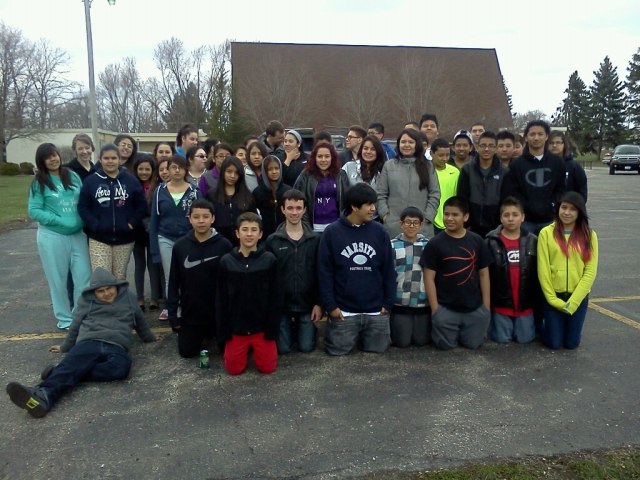
Picture of Heaven: Maranatha Chapel in Evergreen Park, IL

For Mission On Our Doorsteps I interviewed Pastor Doug Banks of Maranatha Chapel in Evergreen Park, IL. Maranatha is a fascinating case study of a congregation in touch with it’s changing community and that does multi-ethnic ministry excellently.  It is, I think, a vision of what the Church will inevitably increasingly look like in North America.

Maranatha Chapel at a Glance:

Vision: One Message/Many Languages

-Congregations:

  • English (multi-ethnic: 50% white, 10% African, 15% African American, 20% Hispanic, 5% Filipino). 150 ASA at 10AM
  • Spanish: 125 ASA at 12noon
  • Arabic: 60 ASA at 3PM
  • Messianic Jewish: 30 ASA on Fridays at 7:30PM

Finances and Leadership: One budget, one board, one senior pastor, one youth pastor, one worship pastor, one Christian education director, 3 ethnic specific pastors (Spanish, Arabic, Jewish).

-Denomination: Assemblies of God

History:

In the year 1999 Maranatha Chapel was looking for a new senior pastor and was considering hiring Doug Banks, a returning Assemblies of God missionary in Mexico. When it was time for a congregational vote Doug told the congregation “I would like this congregation to reflect the demographics of the community that we live in. If you don’t want to move in this direction don’t vote for me.” Doug received 99% of the vote of the then primarily Caucasian congregation, although there was some fear as to what this new direction for the church would entail.

In speaking with some SIM missionaries who were a part of the congregation he realized the need for some early cross-cultural “wins” to dispel the fears that were present and to help the folks get a taste for multi-cultural ministry. Two events were organized.

The first entailed a multi-church worship service during the Christmas season in which several ethnic congregations joined with Maranatha for a simple one hour service, with each congregation getting 15 minutes to present 2 songs in their own language and then in English to share the significance of Christmas in their own country and culture. A French speaking Haitian, a Hispanic and a Arabic congregation participated. The event was to start at 6PM and at a quarter to 6 the only ones present were the Caucasians from Maranatha who started getting nervous that no one else was going to show up. At five to six the Haitians showed up. At five minutes after six the Arabs showed up and then at 6:15 the Hispanics showed up. After the service there was a potluck and opportunity for everyone to fellowship and get to know each other. The second easy “win” involved partnering with a local organization to welcome Chinese university students by having families in the church adopt them and then invite them to a special church service in which they were prayed for. For many of the Chinese this was their first time in an American home, even though they had been in the US for several years already, and the first time they visited an American church. For the Maranatha members as well as the students it was a powerful experience. Both of these events helped to dispel the fear and clear the path towards becoming a more diverse church.

That year 2001 they began a Spanish speaking service and the next year an Arabic speaking service, less than a year after 9/11.

For a time there was an African service in English, but with an “African flair” but soon these members asked to be integrated to the main English service which they did. The latest addition is a Messianic Jewish Shabbat service on Friday evenings.

How does this congregation handle some of the most common hurdles in doing multi-cultural ministry under the same roof? What have been some of the necessary ingredients and components of this successful model?

Leadership:

“It’s all in the leaders” says Pastor Doug referring to this model of multi-ethnic church. At Maranatha there is one leadership board that is diverse and is comprised of leaders from each of the congregations. Pastor Doug says this was never “mandated” or “forced” but came into being naturally. Doug is the senior pastor for the whole church, while each language specific congregation having a leader. There is also one youth pastor who serves the whole church and one worship pastor who acts as a coach for each of the language

specific worship teams. The leadership team meets weekly for prayer, vision and planning. “This model of church is a lot of work and requires a lot of meetings” to keep things flowing smoothly. Maranatha is also unusual in that they have grown their own leaders from within. They have even sent out leaders to help start or lead other congregations. One of the Arab leaders is now in Jordan leading an Arabic church and an early Hispanic leader is now leading a Hispanic congregation in another neighborhood of Chicago.

Finances:

There is one budget for the whole church. “This takes a huge burden off of the congregations and frees them up to focus on their strengths: reaching their own people groups” says Pastor Doug.

Children and Youth:

On Sunday each congregation has its own Sunday school classes led by their own team of leaders and volunteers. The importance of this was an early lesson that Doug learned. Initially there was a caucasian children’s pastor that was leading the Sunday school for each group, but this inhibited the growth and potential of each congregation. Once they were each required to step-up and provide their volunteers and leaders things became much more healthy. On Tuesday evenings (“Mega Ministry Tuesdays”) there is one youth and children’s program that incorporates the students from all of the congregations and those of families that are in the ESL outreach program. Many of the older 2nd generation immigrants from each of the congregations have now begun to migrate over to the English speaking service which has become increasingly multi-ethnic. “At first some of the parents were uncomfortable with this, but we told them ‘it’s the same church’ it’s just a service at a different time.”

Mission/Outreach:

The ESL outreach is a key component of the church and a key way new families are integrated into the various congregations. It also helps the church “keep a pulse on the community” and on what new people groups are moving in, whether Lithuanians, French Speaking Africans or Polish people.

Because of their multicultural ministry Maranatha’s local ministry has had global impact. Chinese doctors coming to their ESL program have returned to China. One of their Arab leaders is now pastoring a church in Jordan.

In reaching out to a local densely Hispanic neighborhood, the Hispanic congregation encountered many Caucasians and English speakers and so now are partnering with the English congregation of Maranatha to reach out. They have made teams of 3 in which each team has a man, a woman and an English speaker.

Balancing Unity and Diversity:

In general Maranatha seems to have done a remarkable job in balancing unity and diversity: unity but not uniformity and diversity but not disparity.

On the “mega-Tuesdays” there is “big synergy” by being all together in the same place and time. Besides the ESL outreach and the youth and children programming there is the International School of Ministry curriculum, a Bible study curriculum that is in 60 different languages. Each congregation has a study on Tuesday nights using this curriculum. “One time a week we are learning the same thing but each in their own language.”

Gifted Cross-Cultural Facilitators:

Key to the Arabic Ministry has been a SIM missionary couple that are gifted in crossing cultures and facilitating connections. Over the years they have acted as a sounding board to Pastor Doug and have helped bridge the Arabic cultural differences and conflicts that have arisen. Though they have never had an official pastoral role they have functioned as “strategic leaders for the whole church” and Arabic ministry in particular.

Posted in Immigrant church, Missional Strategy, multi-ethnic church, Partnership | 2 Comments

Recent Blog Post: Jonathan KindbergGeneration Dynamics in Immigrant Churches/Dinámicas Generacionales dentro de Iglesias Inmigrantes

I remember an English Sunday school class I was leading with Hispanic high-school students, while their parents were in a Spanish service. We were just beginning the book of Mark and were going in turns with each person in the circle reading several verses of a chapter. One student began to read: “The beginning of the good news about Heysoos the Messiah…” pronouncing Jesus’ name as “Heysoos” the anglicized version of the Spanish Jesús. This was both shocking and eye opening to me. Why did he pronounce it that way? First, I realized that this was probably this kids’ first time reading the Bible in English. Although he had grown up going to church, it was all in Spanish (his parent’s language) and so he really hadn’t heard in English (his preferred language) much about Jesus. Second I realized that in many Hispanic families, boys are given the name “Jesús.” Living in the U.S. in an environment dominated by English and English speakers who can’t pronounce names in Spanish very well, Jesús ends up getting pronounced “Hay-soos.” It’s Jesus in Espanglish. This experience awoke me to the tensions and dynamics of the second generation experience.

Daniel Rodriguez, citing the Pew Hispanic Center states, surprisingly, that 62% of all Hispanics/Latinos in the U.S. are native born and that of these only 4% are Spanish dominant.

First generation Hispanics are Hispanics that have immigrated to the United States from another country and prefer their native language and culture. However, when these immigrants have children (second generation Hispanics) they, by the fact of growing up in an English dominant school system and culture prefer English, though they are usually bilingual. By the time the second generation has kids, their kids (third generation Hispanics) are fully integrated into American culture and usually don’t speak Spanish at all. It is not uncommon to find third-generation grandchildren who are unable to speak to their first generation grandparents. This happens across the board and is not unique to Hispanic immigrants. Think of all the Americans who are descended from Swedish, German, and Italian immigrants…how many of them still speak Swedish, German or Italian?

As we think of the future of the Latino church and of the Anglican Church in US in general, reaching second generation Hispanics and doing church in a way that ministers to their unique needs is must. At this year’s Caminemos Juntos gathering in Fresno, CA, we will be talking about how to reach this unique population. We will also have a special session for 2nd generation Hispanic youth and encourage all leaders who are coming to bring with them a youth representative from their church.

Resumen:
Me acuerdo de un estudio bíblico en ingles que yo estaba dirigiendo con un grupo de adolecentes hispanos mientras sus papás estaban en un servicio en español. Estábamos recién empezando a leer juntos el evangelio de San Marcos y me di cuenta de que la mayoría de estos estudiantes, aunque habían estado en la iglesia casi toda sus vidas, no conocían mucho de Jesús y mucho menos habían escuchado de él en ingles. El problema era que ellos habían pertenecido a una iglesia de habla hispana por casi todas sus vidas que hacía todo en español aunque su idioma preferido es el inglés. Estos jóvenes no habían sido discipulados y estaban a punto de desaparecer de la iglesia. Este es el reto generacional en la cual se encuentra la iglesia inmigrante en Norte América. Los hispanos de segunda generación, nacidos en Estados Unidos, prefieren el inglés y muchas veces no pueden leer o entender bien el español. Los cultos y servicios que han sido planeados para sus padres y abuelos (los de primera generación) no son relevantes para ellos. Cuando la segunda generación tiene hijos (tercera generación) estos Hispanos ya no hablan español.

En una encuesta a nivel nacional por el Pew Hispanic Center, se descubrió que 62% de Hispanos en USA son nacidos aquí y de ellos solo 4% prefiere el español.

Es tiempo que la iglesia latina empiece a darse cuenta de estos cambios. En la conferencia de Caminemos Juntos de este año estaremos hablando de cómo alcanzar la segunda generación de Hispanos que son el futuro de la iglesia. Tendremos también una sesión diseñada especialmente para los jóvenes de segunda generación y animamos a todos los que vienen que traigan a un joven de su iglesia también.


Posted in 2nd Generation Youth, Immigrant church, Reflecciones En Espanol | Leave a comment

Por la gracia de Dios…

By the grace of God and the laying on of hands by Archbishop Robert Duncan, I was made a deacon in the One, Holy, Catholic and Apostolic Church on the feast of St. Philip and St. James, Apostles, Tuesday, May 1st, 2012.

This slideshow requires JavaScript.

For more pictures from Bethany Hope Photography click here.

Posted in Personal Updates | Leave a comment

Conociendo al Cristo que no es Victima Sino Vencedor

Si cierras tus ojos y te imaginas a Cristo, ¿como se ve? Yo pienso que la mayoria de las personas visualizan a Cristo crucificado o al Cristo de la pelicula la Pasion de Cristo: un Cristo ensangrentado y sufriendo. Visualizan al Cristo victima. En el mundo Catolico Hispano la mayoria de la imagenes que vemos reflejan este Cristo.

Cristo si sufrio y si murio, pero no fue victima. Nadie le quito su vida, sino que el la dio libremente. Cuando Pedro trato de defenderlo con violencia, lo paro, y sano a su enemigo. Facilmente hubiera podido llamar a diez mil angeles a defenderle, pero no lo hizo. Morir era su mision, su proposito por la cual vino a este mundo. En Juan 10:18 Jesus dice: «Nadie me quita la vida, sino que yo la doy por mi propia voluntad. Tengo el derecho de darla y de volver a recibirla. Esto es lo que me ordenó mi Padre.» Una victima es alguien quien sufre impotentemente a causa de otra persona. Es debil y no puede defenderse. Pero Jesus no fue una victima:  el dio su vida libremente. Nadie se la quito.

Pero aun mas, Jesus no quedo muerto: Resucito! Vencio al enemigo mas potente de este mundo: la muerte. Le robo a Satanas su arma mas fuerte y lo dejo impotente. Regreso a la vida para darnos a nosotros vida.

Mucha gente no conoce a este Cristo. Muchos, especialmente en la comunidad Hispana, que tanto conoce el sufrimiento y la opresion, no conocen el poder y la victoria del Cristo vivo, del Cristo que resucito. Los que conocen al Cristo vivo, el vencedor, el que no fue victima, no se dejan ser victimizados tampoco. Los que conocen al Cristo vivo empiezan a vivir vidas de victoria tambien. Aunque se enfrentan a dificultades, con el poder de Cristo los enfrentan con confianza y valentia….y los sobrepasan. Ya no tienen miedo. Y como dijo tan famosamente Cesar Chavez: “A los que ya no temen no se les puede oprimir.”

Posted in Reflecciones En Espanol | Leave a comment

Spring 2012 Greenhouse Youth Retreat

This slideshow requires JavaScript.

Posted in 2nd Generation Youth, Pictures | Leave a comment

Caminando Con Cristo on Good Friday

This last week I had a post-holy week debrief with my leadership team from Iglesia de la Resurreccion and Santa Cruz. As we went around the circle, each individual told their most memorable moment of Holy Week. To my surprise, almost every leader mentioned our Good Friday procession.

One of my leaders told how this procession helped them enter into to the reality of Jesus’ suffering. One leader mentioned how it brought her back to her childhood days of walking in procession during Holy Week with her grandmother in Mexico. “These traditions are a part of our heritage, but when we come to this country they are lost. No one does processions here.” For many it was the first time in years that they had been a part of one.

What exactly was this procession? On Good Friday, Iglesia de la Resurreccion joined with our new church plant, Santa Cruz, to do an outdoor stations of the cross through neighborhood streets in Glen Ellyn. We sang and walked, pausing at various points for readings and prayers, marking each step of Jesus’ journey towards Golgotha. Our journey began with a prayer: “Lord, allow us to walk with you in remembrance of these sacred mysteries” and between each stations we sang “I will walk in the presence of the Lord.”

At the stripping of Jesus’ clothes we prayed for the homeless and the naked. When Jesus’ cross was taken by Simon of Cyrene, we prayed for immigrants and a just immigration policy. When his hands and side were pierced we prayed for all those suffering from violence in Mexico and Latin America.

The response from those we passed by was mixed. As we went by the first house, the windows which were partly open were quickly shuttered closed. Some passersby exchanged bewildered looks and hurried on their way.  At another house, as we paused to do the readings for one of the stations, a man reverently knelt down at his window in prayer.

For all of us it was a vivid reminder of the public and scandalous nature of Jesus’ crucifixion and death and of Jesus’ invitation to walk every day and everywhere in the light of his presence.  It brought all the more close to home our parish’s mission statement: “walking with Christ, transformed by him, transforming the world. Caminando Con Cristo, Cambiados por el, Cambiando al mundo.

Posted in Iglesia de La Resurreccion, Immigrant church, Santa Cruz | Leave a comment

Fotos de Holy Week/Semana Santa

Pictures from our whole parish (Resurreccion, Santa Cruz and Briar Street) Holy Week services  

This slideshow requires JavaScript.

Posted in Pictures | Leave a comment

Hospitality and Space Sharing

Let all guests who arrive be received like Christ, for he is going to say, “I came as a guest, and you received me.” Rule of St. Benedict

“After 30 days a guest becomes family.”  Arab proverb

Over the next 3 years the Mission On Our Doorsteps movement, which I help lead, is focusing on 4 key initiatives in which we hope to spark transformation: immigration, human trafficking, generational issues in immigrant churches and host and hosted church relationships.  At the last conference I was privileged to help facilitate the host and hosted church relationship track and to listen in on what became a fascinating and engaging time of  honest dialog between immigrant church leaders and predominantly Anglo church leaders who are hosting immigrant churches in their buildings.

The reality of multiple churches, including immigrant churches, sharing the same church building is increasingly becoming the norm around the country-especially in urban areas. In a study done of 617 congregations in Boston, Cambridge and Brookline, Massachussets 32% share worship space with at least one other congregation. These space sharing scenarios are pregnant with kingdom potential but also with the potential for kingdom conflict.

The theme of hospitality was one of the topics which arose in the midst of the conversations conversation between leaders at Mission On Our Doorsteps.

In the West we Anglos have generally lost the virtue of hospitality, a virtue highly valued and deeply practiced in much of the rest of the cultures of the world. Eating together in someone else’s home or simply drinking together an evening cup of coffee, a daily experience in the Global South, is becoming a rare thing in the dominant culture in North America. When hospitality is practiced, we have watered it down and made it “soft sweet kindness, tea parties, bland conversations and a general atmosphere of coziness” to those who are like us, as Henri Nouwen says in his book “Reaching Out.” We have forgotten the risky, costly nature of hospitality as a welcoming in of the stranger and hospitality to the other as a two way exchange in which the guest is receiving the gifts of the host and the host is giving room for the expression and reception of the gifts of the guests. Hospitality as mutual exchange and enrichment.

Christine Pohl in her work “Making Room: Recovering Hospitality as a Christian Tradition” states:  “I believe that hospitality…means to give of yourself…(in) other types of services you can give of your talents or…skills or…resources…The tasks aren’t what hospitality is  about, hospitality is giving of yourself.  If hospitality involves sharing your life and sharing in the lives of others, guests/strangers are not first defined by their need.  Lives and resources are much more complexly intertwined, and roles are much less predictable” (p. 72).

What would it look like if this kind of radical hospitality were to permeate the church today? How would our buildings be used differently? What if we all, Anglo and minority church leaders, began to see the “other” as a blessing to be received rather than a danger to be avoided? How would our relationships look with those whom we shared building space with? What if we began to see “the guest as a guest of God,” as a middle-eastern proverb states? I think this would radically change the  nature of host and hosted church relationships and the face of the church today.

Posted in Immigrant church, Missional Strategy, Partnership | Leave a comment

Multiethnicity: A North American Missional Mandate

“As many lament the decline of Christianity in the United States in the early stages of the twenty-first century, very few have recognized that American Christianity may actually be growing, but in unexpected and surprising ways [especially via the growth of the immigrant church]. The American Church needs to face the inevitable and prepare for the next stage of her history – we are looking at a nonwhite majority, multiethnic American Christianity in the immediate future. Unfortunately, despite these drastic demographic changes, American Christianity remains…disconnected from both [this] global and local reality.” (Soong-Chan Rah, “the Next Evangelicalism” p.12).

Thanks to Philip Jenkins and his book “the Next Christendom” many have come to realize that the center of global Christianity is no longer the west, but the global south. The majority of World Christians are non-white. As Anglicans we have known this reality for some time given our close connection to the Global South and their rescuing of us from the collapse of the Episcopal church in recent years. As a young participant at the Global Anglican Future Conference in Jerusalem in 2009 this statistic was visually made clear to me, by the dark sea of of bishops and priests present representing the Global South.

What most don’t realize, however, is that this same dynamic is underway in North America and very soon will also be the reality. Not only are “the great majority” of immigrants who are coming to the US Christian in background, but immigrants in general are one of the groups that is most open to the Gospel and is seeing rapid numbers of new churches started throughout the country. Christianity in North America is changing. In recent years, the denominations who have not seen an overall decrease is membership have to thank the the growth of immigrant churches in their midst. The big “C” Church in North America will soon be majority non-white as will be the culture in general. By 2042 the majority of US residents will be non-white. Unfortunately, the overall lily white Anglican church has not awakened to this reality and our demographics do not represent the change evident in our society. This must change if we are to stay relevant. This must become a moment of transition for us.

During his investiture, Archbishop Bob Duncan made the astonishing, prophetic call for 1000 new churches to be planted during his ministry. This call has changed the subject of conversation in the Anglican church towards mission. Much has been accomplished in the last two and a half years, but much work remains. If we are to truly reach 1000 churches – or more importantly than the numbers truly impact our surrounding society – we must become a multi-ethnic movement, we must plant both multi-ethnic churches as well as churches among specific ethnic and immigrant groups. Until now we have missed some of the most fertile soil for the gospel and a large percentage of our country’s demographic. There are encouraging signs that there is an openness to this:  ¡Caminemos Juntos! and Jubilee are two signs that change is underfoot.

Posted in Immigrant church, Missional Strategy | 1 Comment

By the grace of God…

Posted in Personal Updates | 1 Comment